Physics Notes - Herong's Tutorial Notes - v4.01, by Herong Yang
Types of Photon-Atom Interactions
This section introduces types of photon-atom interactions: absorption, ionization, elastic scattering, inelastic scattering, stimulated emission, and passthrough.
When a photon hits an atom, it will interact with the atom in several ways called: absorption, ionization, scattering, stimulated emission, and passthrough.
Absorption - The photon disappears. Its energy is transferred to an electron in the atom. The transferred energy causes the electron to jump to a higher energy orbit.
Ionization - The photon disappears. Its energy is transferred to an electron. The transferred energy causes the electron to escape out of the atom. This is also called photoelectric effect.
Scattering - The photon interacts with the atom and generates a new photon.
Stimulated Emission - The photon passes through the atom without any changes. But it triggers an election to drop from a higher energy orbit to a lower energy orbit and release a new photon identical to the incoming photon.
Passthrough - The photon passes through the atom without any interfactions.
Scattering interactions can be divided 3 types:
1. Rayleigh Scattering (named after Lord Rayleigh) - The incident photon disappears. Its energy is transferred to an electron in the atom. The transferred energy causes the electron to oscillate at the same frequency of the incident photon, and creates a radiating dipole, which produces the scatted photon with identical properties as the incident photon. The same energy from the incident photon is carried away by the scattered photon.
Rayleigh scattering is considered as an elastic scattering, because the scattered photon identical to the incident photon. There is no change in wavelength, frequency and energy.
The following diagram from a research paper at www.mdpi.com/2073-4433/12/7/918 depicts a Rayleigh scattering interaction.
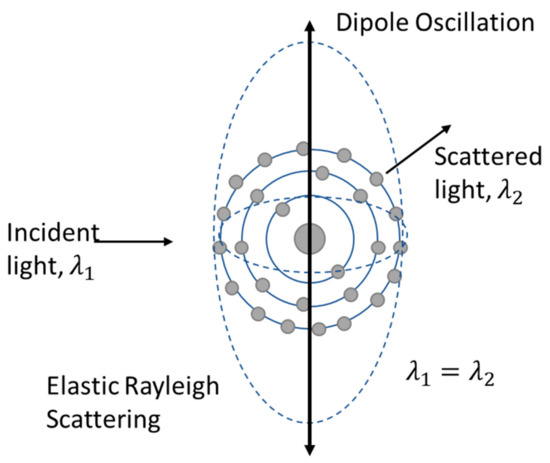
Note that the radiating dipole created by the incident photon can be viewed as at the electon, atom or molecule level.
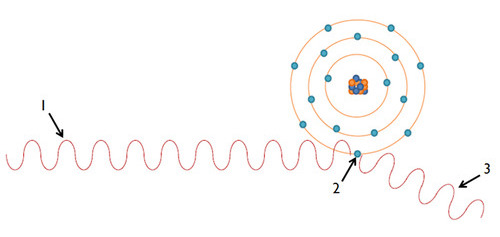
2. Thomson Scattering (named after Joseph John Thomson) - It happens The incident photon collides with a loosely bound electron in the atom (or a free electron). When the photon's energy is much smaller than the mass-energy of the electron, the collision accelerates the electron, which produces the scatted photon with identical properties as the incident photon. The same energy from the incident photon is carried away by the scattered photon.
Thomson scattering is considered as an elastic scattering, because the scattered photon identical to the incident photon. There is no change in wavelength, frequency and energy.
The following diagram from a research paper at quizlet.com/539534129/quiz-4-flash-cards/ depicts a Thomson scattering interaction.
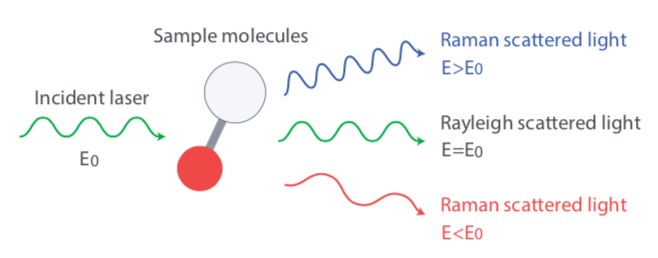
3. Raman Scattering (named after Arthur Holly Compton) - The incident photon interacts with the atom in the same way as Rayleigh scattering. But the scattered photon has less or more energy than the incident photon.
Raman scattering is considered as an inelastic scattering, because of the difference in energies carried by the incident photon and scattered photon.
The following diagram from a research paper at www.nanophoton.net/lecture-room/raman-spectroscopy/lesson-1-1 depicts Raman scattering interactions in relation to the Rayleigh scattering.
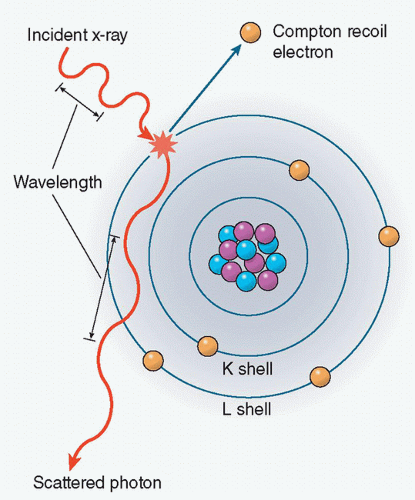
4. Compton Scattering (named after Arthur Holly Compton) - The incident photon interacts with the atom in the same way as Thomson scattering. But the scattered photon has less or more energy than the incident photon.
Compton scattering is considered as an inelastic scattering, because of the difference in energies carried by the incident photon and scattered photon.
The following diagram from a research paper at radiologykey.com/x-ray-imaging-fundamentals/ depicts a Compton scattering interaction.
A good introduction on how x-rays interact with the human body during an x-ray exposure is provided at howradiologyworks.com/x-ray-interactions/. It covers photoelectric effect, Compton scattering and elastic scattering.
Table of Contents
Introduction of Frame of Reference
Light Spectrum - Range of Electromagnetic Frequencies
Stimulated Emission of Radiation and Laser
Superposition of Electromagnetic Field Waves
►Types of Photon-Atom Interactions
Light Interacting with Flat Surface
Introduction of Special Relativity
Time Dilation in Special Relativity
Length Contraction in Special Relativity
The Relativity of Simultaneity
Minkowski Spacetime and Diagrams
Introduction of Generalized Coordinates