Physics Notes - Herong's Tutorial Notes - v4.01, by Herong Yang
Superposition of Electromagnetic Field Waves
This section describes how individual electromagnetic field waves superpose together to form a new electromagnetic field wave.
Superposition (also called interference) of light waves (electromagnetic field waves) follow simple vector addition operations of electric fields and magnetic fields of individual waves:
        Es = E1 + E2
        Bs = B1 + B2
where:
        E1 and E2: the electronic vector fields of the individual wave 1 and 2
        E2: the electronic vector fields of the superposed wave
        B1 and B2: the magnetic vector fields of the individual wave 1 and 2
        Bs: the magnetic vector fields of the superposed wave
        +: the vector addition operation
Here are some simple light superposition cases:
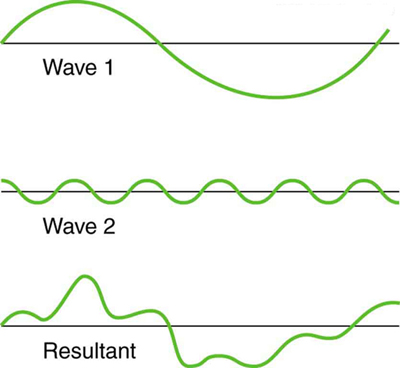
Frequency Superposition - When 2 uniform light waves with the same polarization direction and different frequencies travel together along the same line, they are superposed into a multi-frequency wave. The diagram below illustrates this type of superposition:
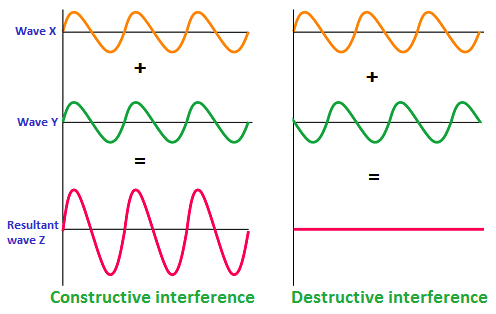
Phase Superposition - When 2 uniform electromagnetic waves with the same polarization direction, the same frequency, travel together out of phase and along the same line, they are superposed into a single uniform electromagnetic wave with amplified or reduced oscillation strength depending on their phase difference.
When 2 waves travel perfectly in phase (their crests and troughs always aligned), their oscillations are canceled, the oscillation the resulting wave is 2 times stronger than the original waves. This is also referred as constructive interference.
When 2 waves travel completely out of phase (the crest of one wave is aligned to the trough of the other wave), their oscillations are canceled out resulting a superposed wave with no oscillation. This is also referred as destructive interference
The diagram below shows us 2 light superposition cases, constructive interference and destructive interference:
In the case of destructive interference, we have some questions to be answered: does the resulting light actual exit without oscillations of electronic and magnetic fields? how to the energy is carried in the resulting light?
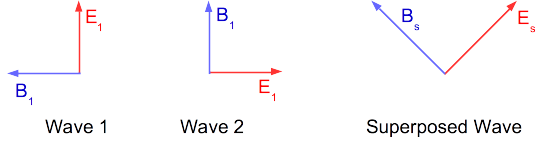
Polarization Shifting When 2 uniform electromagnetic waves with different polarization directions, the same frequency, travel together in phase and along the same line, they are superposed into a single uniform electromagnetic wave with a polarization direction shifted to the middle of the original waves.
The diagram below shows us the superposition of 2 light waves, perfectly in phase, but with a 90 degree difference in their polarization directions.
Polarization Rotation When 2 uniform electromagnetic waves with different polarization directions, the same frequency, travel together out of phase and along the same line, they are superposed into a non-uniform electromagnetic wave with a polarization direction rotating at constant angular speed.
For example, if the two waves travel out of phase by 1/4 of the wave cycle, the superposed wave will a rotating polarization with electric field and magnetic field oscillating in a circular pattern as show below.
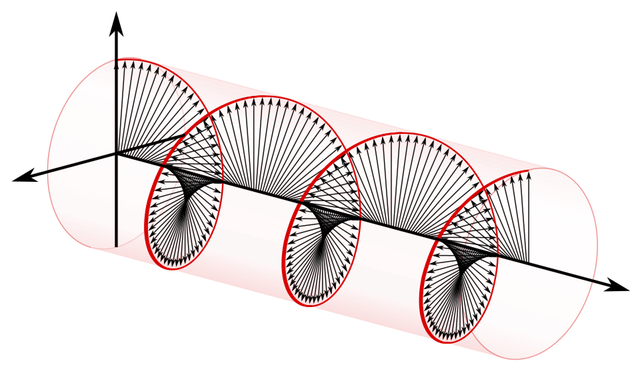
Table of Contents
Introduction of Frame of Reference
Light Spectrum - Range of Electromagnetic Frequencies
Stimulated Emission of Radiation and Laser
►Superposition of Electromagnetic Field Waves
Types of Photon-Atom Interactions
Light Interacting with Flat Surface
Introduction of Special Relativity
Time Dilation in Special Relativity
Length Contraction in Special Relativity
The Relativity of Simultaneity
Minkowski Spacetime and Diagrams
Introduction of Generalized Coordinates