Physics Notes - Herong's Tutorial Notes - v4.01, by Herong Yang
Stimulated Emission of Radiation and Laser
This section describes spontaneous and stimulated emission of radiation with atoms in exited state.
What Is Stimulated Emission of Radiation? Stimulated Emission of Radiation is a physical phenomenon where an incoming photon triggers an excited atom to release a second, identical photon.
Stimulated emission was a theoretical discovery by Albert Einstein published in a paper in 1917. In the same paper, he introduced both spontaneous emission and stimulated emission processes:
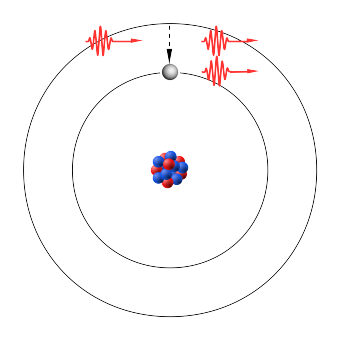
Spontaneous Emission - When an electron at a higher-energy and unstable orbit drops to a lower-energy orbit in an excited atom without any interference, a photon will be released with a random direction and a random polarization. The photon's energy equals to the energy difference between the two electron orbits.
Stimulated Emission - When an electron at a higher-energy and unstable orbit in an excited atom is interfered with a passing photon (electromagnetic wave packet) carrying the same energy as the difference between the higher-energy and a lower-energy level, the electron will drop to the lower-energy orbit and release new photon identical to the passing photon. Both photons travel in phase.
The following diagram shows us the stimulated emission radiation phenomenon:
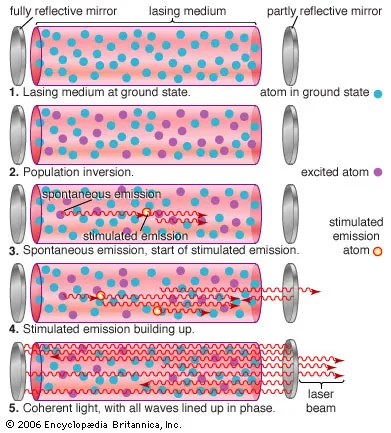
Stimulated Emission Used to Generate Laser - Laser (acronym of Light Amplification by Stimulated Emission of Radiation) is a good example of utilization of the stimulated emission radiation phenomenon.
Here are the base steps of the laser generation process:
- Lasing medium with atoms in ground state (electrons at lower-energy orbits) is placed in a tube between 2 mirrors, one of which is half-silvered.
- Lasing medium is pumped by external energy to excited state (electrons at higher-energy orbits)
- Spontaneous emission is started to release photons randomly.
- Photons traveling along the axis of the tube get bounced back and forth between the 2 mirrors, triggering stimulated emission to build up more and more photons traveling along the axis of the tube.
- Some photons traveling along the axis of the tube. are emitted through the half-silvered mirror to form the laser beam.
Power, Energy and Photon Counts - Since all photons in a laser beam have identical properties, we can relate the power, energy and photon counts with the following equations:
        c = νλ
        E = hν
        E = hc/λ
        NE = Pt
        N = Pt/E
        N = Pt/(hν)
        N = Ptλ/(hc)
where:
        c: Speed of light, 299,792,458 m/s
        E: Single photon energy in Joules (J)
        h: Planck constant, 6.62607015 × 10⁻³⁴ J/Hz
        N: Number of photons
        P: Power in Watts (W)
        t: Time in seconds (s)
        ν: Frequency of photo in hertz (H)
        λ: Wavelength of photon in meters (m)
For example, a green laser generator with 1 Watt output of 520 nm wavelength laser beam can generate 2.6177406151222 × 10¹⁸ photons in 1 second.
        N = Ptλ/(hc)
            = 1 × 1 × 5.2 × 10−7 / (hc)
            = 5.2 × 10⁻⁷ / (299792458 × 6.62607015 × 10-34)
            = 5.2 × 10⁻⁷ / (1986445857.1489 × 10-34)
            = (5.2/1986445857.1489) × 1027
            = 2.6177406151222 × 10-9 × 1027
            = 2.6177406151222 × 10¹⁸
Table of Contents
Introduction of Frame of Reference
Light Spectrum - Range of Electromagnetic Frequencies
►Stimulated Emission of Radiation and Laser
Superposition of Electromagnetic Field Waves
Types of Photon-Atom Interactions
Light Interacting with Flat Surface
Introduction of Special Relativity
Time Dilation in Special Relativity
Length Contraction in Special Relativity
The Relativity of Simultaneity
Minkowski Spacetime and Diagrams
Introduction of Generalized Coordinates