Physics Notes - Herong's Tutorial Notes - v4.01, by Herong Yang
Light Interacting with Flat Surface
This section descrives the interaction of light at a flat surface of 2 different medium.
When a single photon hits a flat surface, the interaction is pretty random. It could be absorption, ionization, scattering, stimulated emission, or passthrough, as described in the previous section.
But if we hit a flat surface with a beam of light (lots of photons), called incident light, the interaction divides it into 3 portions called: reflected light, refracted light and absorbed light, as shown in the diagram below:
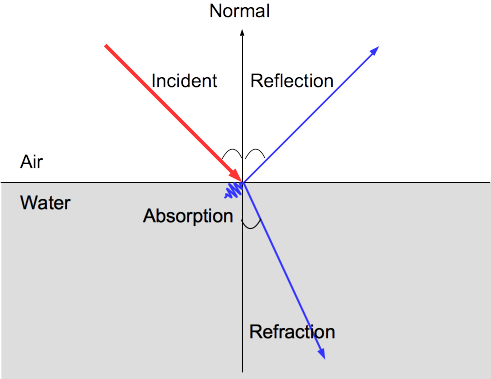
Reflected Light - The portion of the incident light that gets reflected back from the surface. It follows the reflection law:
1. The reflected light lies in the plane formed by the incident light and the normal line of the surface at the incident point.
2. The reflection angle between reflected light and the normal line equals to the incident angle between the incident light and the normal line.
3. The intensity of the reflected light is proportional to the intensity of the incident light.
Refracted Light - The portion of the incident light that passes through the surface. It follows the refraction law, also called Snell's law, named after Willebrord Snellius:
1. The refracted light lies in the plane formed by the incident light and the normal line of the surface at the incident point.
2. The refraction angle between refracted light and the normal line is related to incident angle between the incident light and the normal line based on the following equation:
        n1 × sin(θ1) = n2 × sin(θ2)
where:
        n1: refractive index of the medium where incident light comes from
        n2: refractive index of the medium where refracted light goes into
        θ1: incident angle
        θ2: refraction angle
3. The intensity of the refracted light is proportional to the intensity of the incident light.
Absorbed Light - The portion of the incident light that gets absorbed by the surface. Intensity lost in absorption is proportional to the intensity of the incident light.
Example 1: Let's hit a water surface with a laser beam straight forward from air at a 45-degree angle downward. Given the refractive indexes for air and water of 1.00 and 1.33, the interaction will produced the following:
The reflected light will be:
- Back to the air straight forward.
- Upward at a 45-degree angle.
- About a 2.75% of the incident intensity.
The refracted light will be:
- Into to the water straight forward.
- Downward at a 32-degree angle.
- About a 97.25% of the incident intensity.
The absorbed light will be:
- Negligible.
Example 2: Let's hit a polished and flat silver wall with a laser beam from air straight forward. Given the refractive indexes for air and silver of 1.00 and 0.13, the interaction will produced the following:
The reflected light will be:
- Straight backward.
- About a 97% of the incident intensity.
The refracted light will be:
- Negligible.
The absorbed light will be:
- About a 3% of the incident intensity.
Table of Contents
Introduction of Frame of Reference
Light Spectrum - Range of Electromagnetic Frequencies
Stimulated Emission of Radiation and Laser
Superposition of Electromagnetic Field Waves
Types of Photon-Atom Interactions
►Light Interacting with Flat Surface
Introduction of Special Relativity
Time Dilation in Special Relativity
Length Contraction in Special Relativity
The Relativity of Simultaneity
Minkowski Spacetime and Diagrams
Introduction of Generalized Coordinates