Physics Notes - Herong's Tutorial Notes - v4.01, by Herong Yang
Coherent vs. Incoherent Light
This section describes differences between coherent light and incoherent light.
As described in the previous section, photons released from a laser generator are generated from the stimulated emission process. Those photons have identical properties: wavelength, direction, phase, and polarization. They also travel in phase.
Coherent Light - Light formed by photons with identical wavelength, direction, phase, and polarization is called coherent light. A laser is a good example of coherent light.
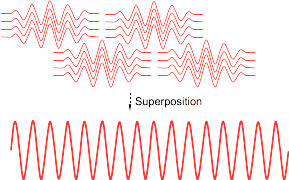
Photons in coherent light are superposed together to form a continuous uniform electromagnetic wave as shown below (magnetic waves are omitted):
From a wavefront perspective, we can have 3 categories of coherent light:
- Single-point coherent light - An idealized laser generator releases identical photons from a single point. And all photons travel in a single line. The wavefront of the laser beam is maintained as a single point.
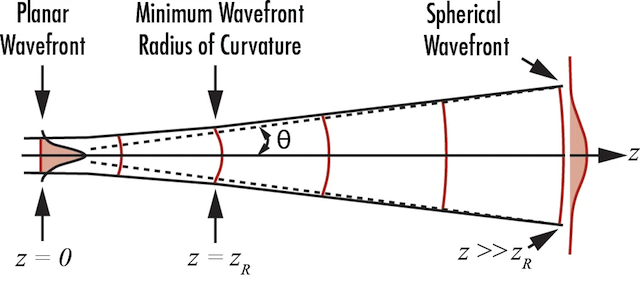
- Non-diverging coherent light - A less ideal laser generator releases identical photons from a small opening. And all photons travel in lines parallel to the center line. The wavefront of the laser beam is maintained as a fixed small flat circle. The this type electromagnetic wave is considered as plane wave or planar wave.
- Diverging coherent light - A real laser generator releases identical photons from a small opening. Photons spread slowly away from the center line. The wavefront of the laser beam starts as a fixed small flat circle, and becomes a large spherical surface over time. The divergence rate of a good laser generator is about 1 milliradians (1 millimeter over 1 meter, or 1 meter over 1,000 meters)
Incoherent Light - Light formed by photons with different properties is called incoherent light. Sun light is a good example of incoherent light.
In an incoherent light beam, photons with identical properties: wavelength, phase, and polarization, form individual continuous electromagnetic waves. Multiple continuous electromagnetic waves with different properties superposed together to form a single overall electromagnetic wave.
So an incoherent light beam wave is a superposition of sub-waves with different wavelengths, and/or phases, and/or polarizations.
Table of Contents
Introduction of Frame of Reference
Light Spectrum - Range of Electromagnetic Frequencies
Stimulated Emission of Radiation and Laser
►Coherent vs. Incoherent Light
Superposition of Electromagnetic Field Waves
Types of Photon-Atom Interactions
Light Interacting with Flat Surface
Introduction of Special Relativity
Time Dilation in Special Relativity
Length Contraction in Special Relativity
The Relativity of Simultaneity
Minkowski Spacetime and Diagrams
Introduction of Generalized Coordinates