Physics Notes - Herong's Tutorial Notes - v4.01, by Herong Yang
Magnetic Force on Moving Charges
This section describes the force exerted on moving electric charges by a magnetic field.
As mentioned earlier in this chapter, magnetic field exerts a force on electrically charged objects that are moving in the field.
This magnetic force is used to define a given magnetic field as a vector function B. At each point (x, y, z) in the electric field, vector B(x, y, z) represents the direction and strength of the magnetic field. B(x, y, z) is defined as:
        F(x, y, z) = q(v × B(x, y, z))
where:
        F(x, y, z) is the force vector exerted on the moving charge
        q is the moving charge passing the point (x,y,z)
        v is the velocity vector of the moving charge
        B(x, y, z) is the magnetic field vector
        × is the cross product operation of vectors
The diagram below shows a positive charge q moving to the right at a speed of v on a magnetic line where the magnetic field B pointing downward. The magnetic field will exert a force F on the charge pointing into the diagram.
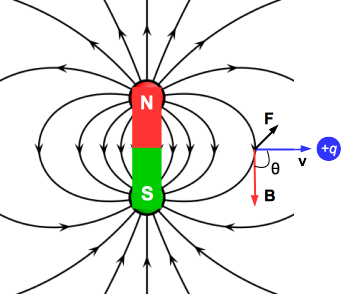
From the definition of the cross product operation, we can derive the formula to calculate the magnitude of the magnetic force on a moving charge as shown below:
        |F| = q |v| |B| sin θ
where:
        θ is the angle between the velocity and the magnetic field
What Is Lorentz Force? Lorentz force, named after Hendrik Lorentz, is the combined force of the electric force exerted on a charge by an electric field and the magnetic force exerted on the same charge if it is moving in a magnetic field.
        F = qE + q(v × B)
where:
        F is the force vector exerted on the moving charge
        q is the moving charge passing the point (x,y,z)
        E is the electric field vector
        v is the velocity vector of the moving charge
        B is the magnetic field vector
        × is the cross product operation for vectors
Now apply Newton's second law of motion, F = ma, to Lorentz force definition, we get the equation of motion of a free particle of charge q and mass m moving in electric and magnetic fields.
        ma = qE + q(v × B)
where:
        m is the mass of particle
        a is the acceleration vector
Table of Contents
Introduction of Frame of Reference
►Magnetic Force on Moving Charges
Moving Charge Creating Magnetic Field
Biot-Savart Law for Magnetic Fields
Magnetic Fields of Current Carrying Loops
What Is Magnetic Dipole and Moment
Introduction of Special Relativity
Time Dilation in Special Relativity
Length Contraction in Special Relativity
The Relativity of Simultaneity
Minkowski Spacetime and Diagrams
Introduction of Generalized Coordinates