Physics Notes - Herong's Tutorial Notes - v4.01, by Herong Yang
Magnetic Fields of Current Carrying Loops
This section describes magnetic fields electric current in a circular wire loop.
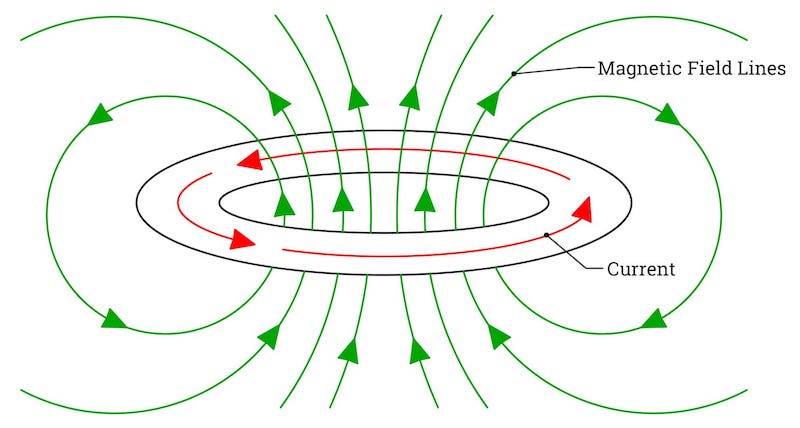
The electric current running in a circular wire loop creates a magnetic field with magnetic lines lined up in donut shapes as shown below:
To calculate the magnetic field B at a generic point P in the space is difficult. But for a given point P on the center line of the wire loop is simple using Biot-Savart law.
First, let's set a special coordinate system (x,y,z), so that the z axis is attached to the center line, and pointing to the magnetic field direction. The x axis passes through the center of the loop, and a point on the loop where we want to perform Biot-Savart differentials as shown in the following diagram from hyperphysics.phy-astr.gsu.edu/hbase/magnetic/curloo.html#c2.
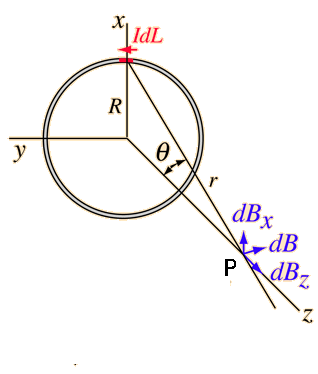
The magnetic field at point P on the center line can be expressed in 3 components using Biot-Savart law:
where:
        |r|3 = r3 is a constant
        ∫C (dl × r)x = 0, because half integration cancels out the other half
        (dl × r)y = 0, because dl is parallel to y
        (dl × r)z = r sin(θ) dl is applied
        ∫C dl = 2πR and sin(θ) = R/r are applied
        θ is the angle between r and -z vectors
        μ0 is the vacuum permeability (4π × 10-7, or 1.2566 × 10⁻⁶)
        I is the current
        R is the radius of the loop
As you can see, the magnetic field vector B at point P on the center line has only z component with a magnitude of:
You can also transform the formula to use x as the distance of P to the center of the loop, instead of r:
where:
        x is the distance of P to the center of the loop
        r2 = R2 + x2 is applied
The magnetic field has the highest magnitude at the center of the loop (x = 0):
Table of Contents
Introduction of Frame of Reference
Magnetic Force on Moving Charges
Moving Charge Creating Magnetic Field
Biot-Savart Law for Magnetic Fields
►Magnetic Fields of Current Carrying Loops
What Is Magnetic Dipole and Moment
Introduction of Special Relativity
Time Dilation in Special Relativity
Length Contraction in Special Relativity
The Relativity of Simultaneity
Minkowski Spacetime and Diagrams
Introduction of Generalized Coordinates