Physics Notes - Herong's Tutorial Notes - v4.01, by Herong Yang
Biot-Savart Law for Magnetic Fields
This section describes Biot-Savart Law for magnetic fields created by electric current in conducting wires.
What Is Biot-Savart Law? Biot-Savart Law, named after Jean-Baptiste Biot and Felix Savart, is an integral equation to calculate the magnetic field created by a uniform current running in a wire.
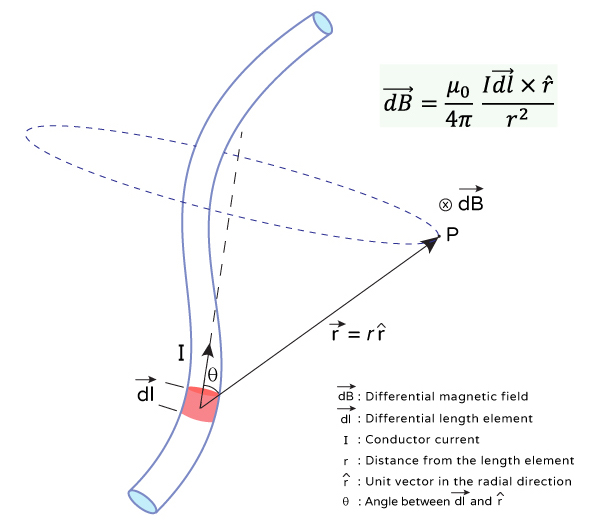
To derive the integral equation of Biot-Savart Law, Let's divide the wire into infinitesimal segments. Each segment, dl, is short enough to be considered as a straight line. And the differential magnetic field, dB, created by such a wire segment for a given position (x, y, z) can be calculated by the differential form of Biot-Savart Law:
where:
        dB is the differential magnetic field vector
        I is the current
        dl is the differential wire segment vector
        r is the distance vector from wire segment to (x, y, z)
        × is the cross product operation of vectors
The diagram below from sciencefacts.net/biot-savart-law.html provides a good illustration of Biot-Savart Law in differential form:
To calculate the total magnetic field created by the entire wire, we can take the integration of the above differential form over the entire wire curve, resulting the integral form of Biot-Savart Law:
where:
        B is the magnetic field vector
        ∫C is the integral of dl over the entire wire curve
How to Calculate the Magnetic Field Created by a Straight Wire? The magnetic field created by the electric current running in a straight wire can be calculated using Biot-Savart Law as shown at physicstasks.eu/1786 /magnetic-field-of-a-straight-conductor-carrying-a-current.
To calculate the magnetic field B at a given point P, we can set a special coordinate system (x, y, z), so that the x axis is attached to the wire from A to B, and pointing to the current direction, The y axis passes through point P as shown in diagram below:
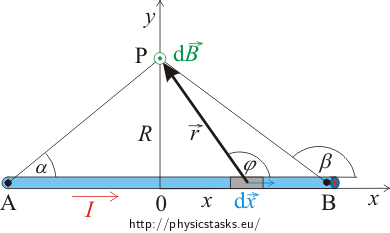
In this coordinate system, the infinitesimal wire segment vector, dl becomes dx. The direction of the cross product, dx × r, is always pointing out of the diagram. So we can take its magnitude, r sin(φ) dx. This allows us to calculate the magnitude of the magnetic field by applying the integral equation of Biot-Savart law:
The above formula can be reduced further by expressing x and r in term of φ:
where:
        r = R / sin(φ) is applied
        dx = (R / sin2(φ)) dφ is applied
        R is the distance between P and the wire
Finally, convert the integral into the difference of boundary values:
where:
        sin(φ) = -cos′(φ) is applied
If the wire is very long, and P is close to the middle of the wire, the magnetic field can be reduced to:
where:
        α becomes 0° approximately
        β becomes 180° approximately
Table of Contents
Introduction of Frame of Reference
Magnetic Force on Moving Charges
Moving Charge Creating Magnetic Field
►Biot-Savart Law for Magnetic Fields
Magnetic Fields of Current Carrying Loops
What Is Magnetic Dipole and Moment
Introduction of Special Relativity
Time Dilation in Special Relativity
Length Contraction in Special Relativity
The Relativity of Simultaneity
Minkowski Spacetime and Diagrams
Introduction of Generalized Coordinates